.avif)
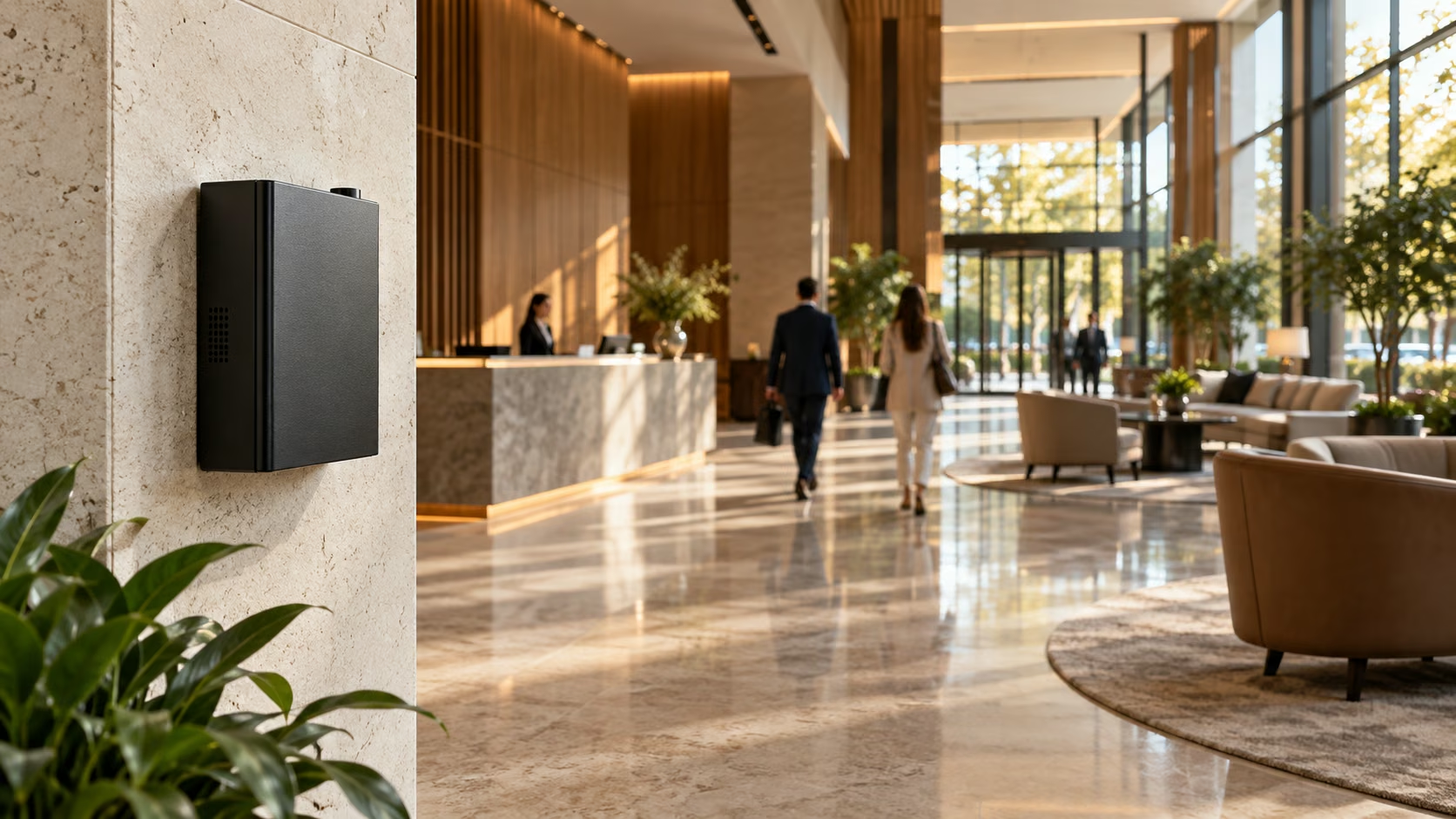
Walk into a hotel lobby, a casino floor, or a newly renovated apartment leasing office, and you form an impression before you notice the lighting or the furniture. Much of that impression arrives through your nose. Scent marketing is the practice of turning that first, half-conscious reaction into a deliberate part of the customer experience.
This guide explains what scent marketing is, why it works, and where it is being used today, from retail floors to hospital waiting rooms. It also covers what to look for in scent marketing solutions, machines, and diffusers, and closes with the latest scent marketing news and the technologies, including AI, shaping where the industry goes next.
What Is Scent Marketing?
Scent marketing is the strategic use of fragrance in a physical space to shape how people feel, how long they stay, and what they remember about a brand. You will also hear it called scent branding, olfactory marketing, or ambient scenting. Unlike a candle on a counter, commercial scent marketing uses professional equipment to disperse fragrance evenly and consistently, often through a building's HVAC system, at a level guests notice without being overwhelmed. For a deeper look at how it works in a real building, see why scent matters.
A complete scent marketing program usually has three parts:
- The fragrance: a scent chosen from a fragrance library, or created as a custom signature blend, to match the brand and the space.
- The delivery system: a scent marketing machine or diffuser sized to the square footage and airflow of the space.
- Ongoing service: fragrance refills, intensity adjustments, scheduling, and equipment maintenance.
Scent marketing is different from commercial odor control. Masking a bad smell is defensive; scent marketing is a proactive design choice, as intentional as a color palette or a music playlist.
Why Scent Matters in Branding
Most businesses invest heavily in what customers see and hear: logos, signage, websites, music. Smell is usually left to chance, which means a space smells like whatever happens to be there, from cleaning chemicals to new carpet to last night's takeout. That is a missed opportunity, because smell is the sense most closely wired to emotion and memory.
That wiring is the foundation of emotional branding: building loyalty through how a brand makes people feel, not only through what it sells. We explore that idea further in how scent connects customers through emotional anchoring. A consistent signature scent turns a location into a recognizable place. Guests returning to a resort, a favorite store, or their gym often notice the familiar fragrance before anything else, and that recognition carries the feelings from their last visit.
For multi-location businesses, scent also delivers consistency. A customer walking into one branch and then another, hundreds of miles apart, can have the same sensory experience, which reinforces the brand the way a uniform logo does. And because relatively few businesses scent their spaces deliberately, a well-chosen fragrance remains one of the clearest ways to stand apart from competitors.
Think of a signature scent the way you think of a logo. Once guests connect a fragrance with your brand, every visit strengthens the link. Hotels, casinos, and retailers that have used the same scent for years find that guests recognize it instantly, and some even ask where they can buy it. That kind of recognition is hard to earn through visuals alone, because visual branding competes with everything else people see in a day.
The Science of Scent
Scent marketing works because of how the brain is built. Of all the senses, smell takes the most direct route to the parts of the brain that handle emotion and memory, and that shortcut is what gives a well-chosen fragrance so much influence over how a space feels.
How Scent Affects Emotions
When you see or hear something, the signal passes through the thalamus, a relay station that sorts sensory information before sending it on. Smell is different. Odor signals travel from the nose to the olfactory bulb, which connects directly to the piriform cortex and the amygdala without a thalamic relay. The amygdala processes emotion, and nearby structures feed into the hippocampus, where long-term and episodic memories form.
In practical terms, a scent reaches the brain's emotional center before the thinking brain has finished deciding what it is. That is why a smell can change your mood before you can name it, and why the scent of sunscreen or a grandparent's kitchen can bring back a memory in vivid detail.
Research backs this up. Psychologist Rachel Herz and colleagues at Brown University used brain imaging to compare responses to odors and other cues. They found that a smell tied to a personal memory produced the strongest activation in the amygdala and the region around the hippocampus, which suggests scent-triggered memories carry unusual emotional weight.
For a business, this means a fragrance does more than make a room pleasant. It attaches a feeling to the place. If guests feel relaxed, welcomed, or energized in a scented space, that feeling becomes part of what they remember, and part of what they feel again the next time they encounter the scent.
This is also why fragrance choice should start with the feeling you want to create, not with a favorite smell. Scent designers often group fragrances by the mood they tend to support. Bright citrus and green notes suit an energetic, fresh feel; soft florals and clean linen suit calm and comfort; warm woods, vanilla, and amber create an inviting, upscale atmosphere. The right family depends on the space and the people in it, which is why a fitness club and a funeral home rarely share a scent. Our guide to choosing the right fragrance walks through the process.
The Psychology Behind Scent Marketing
Decades of consumer research have moved scent marketing from intuition to evidence. A few principles show up again and again.
Congruence matters more than pleasantness. A fragrance has to fit the space, the products, and everything else guests experience. Washington State University researcher Eric Spangenberg and colleagues found that a Christmas scent improved shoppers' opinions of a store and its merchandise only when it was paired with Christmas music. In a separate study, a clothing store was rated more favorably when its ambient scent matched the gender its merchandise targeted. A lovely scent in the wrong setting can work against you.
Simple beats complex. In a study at a Swiss home-goods store, Spangenberg's team compared two scents that were equally pleasant and equally suited to the store. Shoppers exposed to a simple orange scent spent 31.8 percent more on average than those exposed to a more complex blend. The researchers' explanation: when a scent is hard to process, people spend mental effort decoding it instead of engaging with the space. The practical lesson is to keep fragrance profiles clean and recognizable.
Every sense should tell the same story. Congruence extends beyond the products to the look and feel of the space itself. A study from Hasselt University found that when an ambient scent was crossmodally congruent with the store environment, meaning it matched the store's visual and tactile character, shoppers showed stronger approach behavior than with a mismatched scent or no scent. A rustic, wood-paneled space and a bright, minimalist one call for different fragrances, even if they sell similar things.
Scent works below the surface. Most guests never consciously register a well-balanced ambient scent. They simply describe the place as comfortable, upscale, clean, or inviting. That subtlety is the goal: a fragrance strong enough to be noticed is often too strong to be enjoyed for an entire visit.
Scent shapes behavior, not only opinion. In a field study at three dance clubs, pleasant ambient scents increased dancing activity and improved visitors' ratings of the evening, the music, and their own mood compared with no added scent. Similar effects on time spent and willingness to return are why scent appears in casinos, hotels, fitness clubs, and retail stores. For more on how ambient scent changes perception, read how ambient scent changes the way a commercial space is perceived.
Together, these findings point to the core rule of emotional branding through scent: choose a fragrance that fits the brand, keep it simple enough to enjoy, deliver it consistently, and let it work quietly in the background.
Applications of Scent Marketing
Scent marketing first gained traction in hotels and casinos, but today it shows up almost anywhere people gather: retail stores, apartment communities, office lobbies, fitness clubs, senior living communities, funeral homes, dental and medical offices, auto dealerships, and event venues. The goals change by setting. A retailer wants longer visits and stronger purchase intent. A senior living community wants residents and touring families to feel at home. A funeral home wants grieving families to feel comforted and cared for. You can explore each setting on our industries page.
Retail Scent Marketing
Retail scent marketing is the most studied application, and for good reason. Shoppers decide whether a store feels right within seconds of walking in, and scent is part of that decision whether they notice it or not.
Retailers typically use scent in four ways:
- At the entrance to create a welcoming first impression and signal a change from the street or the mall corridor.
- Throughout the sales floor to set a consistent mood that encourages browsing and longer visits.
- In specific departments to reinforce what is being sold, such as a fresh linen note near bedding or a clean, crisp note in athletic apparel.
- In fitting rooms, checkout lines, and restrooms, where a pleasant scent can make waits feel shorter and keep the experience consistent to the last step.
The research in the previous section translates directly into retail practice. Match the scent to the merchandise and the customer. Keep the fragrance simple and recognizable. Coordinate it with music, lighting, and décor so every sense tells the same story. And keep it steady: a store that smells great on Monday and like nothing on Friday is not building an association.
Seasonal scents can work well, too, as long as they stay simple. A clean citrus or a light evergreen will usually outperform a complicated holiday blend, which is exactly what Spangenberg's research on simple versus complex scents would predict. For a practical checklist, see five essentials of scent marketing for a retail business.
Retailers that want proof can measure it. Compare a few weeks with the scent running against a few weeks without it, and track dwell time, conversion rate, average transaction value, and customer feedback. Keep other variables as steady as possible, such as promotions and staffing, so the comparison is fair. Even simple before-and-after comparisons help a store decide which fragrance and intensity work best for its customers.
Retail also shows the power of scent beyond the store. Westin introduced its White Tea fragrance in lobbies worldwide and in a print campaign with a scent strip. Guest demand was strong enough that the brand began selling the scent as candles and diffusers so guests could bring the experience home. When a scent becomes something customers ask to buy, it has become part of the brand.
Scent Marketing Examples from Leading Brands
Some of the best-known scent marketing programs come from hospitality, travel, and food service. Each one shows a different way scent supports a brand.
- Dunkin' in Seoul, South Korea: Released a coffee aroma on city buses whenever its radio jingle played, on routes with stops near its stores. About 350,000 commuters experienced it; store visits rose 16% and sales near bus stops rose 29%.
- Las Vegas Hilton slot floor: Researcher Alan Hirsch scented one slot area, scented a second with a different odor, and left a third unscented. Gamblers in the first scented area spent about 45% more; the other areas showed no change.
- Westin Hotels & Resorts: Introduced a custom White Tea signature scent in lobbies and print ads. Guest demand led Westin to sell the scent for home use.
- Singapore Airlines: Launched Batik Flora, a signature scent built from flowers in its batik motif, extending the brand's sensory identity to lounges and service centers.
The Dunkin' campaign, which won a Bronze Lion at Cannes, is a textbook example of emotional branding. The brand wanted Seoul commuters to think of it as a coffee destination, not only a doughnut shop. Pairing a familiar jingle with the smell of fresh coffee created an association that ads alone could not.
The Las Vegas study is older and small, but it is still widely cited for a reason. It showed that a pleasant scent could change behavior in a measurable way, and that the specific fragrance mattered: one scent moved the numbers and the other did not. That is why casinos remain among the most committed users of scent marketing, and why fragrance selection deserves as much attention as the equipment. Learn more about casino and gaming scent marketing.
Singapore Airlines offers a useful lesson in accuracy. The airline was long linked with a fragrance called Floridian Waters, but it has said that scent was never its signature; it simply used it on hot towels. Starting in late 2021, the airline introduced Batik Flora as a true signature scent. Even a casual association grew strong enough to become part of how travelers remembered the brand, which is the power of consistency at work.
Hospitality brands lean on the same idea. If you have ever wondered why a lobby smells the way it does, read what hotels use to smell so good, or see our approach to hotel and hospitality scenting.
The common thread across these examples is intention. Each brand chose a scent that fit its identity, used it consistently, and connected it to an experience customers already valued.
You do not need a global brand's budget to apply these lessons. A single dental practice, a family-owned funeral home, or one apartment community can follow the same playbook. Pick a fragrance that matches the experience you want guests to have, keep it consistent at every visit, and let it become part of how people remember you. For a smaller business, a distinctive scent can be an even bigger differentiator, because competitors nearby are unlikely to have one.
Scent Marketing in Healthcare
Scent marketing in healthcare is one of the most promising applications, because few environments start with a tougher sensory problem. Clinics, hospitals, dental offices, and imaging centers often smell of disinfectant, latex, or clinical materials, and those smells can trigger anxiety before a patient reaches the front desk. A thoughtful scent program replaces that first impression with one that says clean, calm, and cared for.
The research here is encouraging, and it also shows why execution matters. Scent is not a medical treatment, and it is not a substitute for good care. But as part of the environment, it can measurably change how patients feel while they wait. See how we approach healthcare and medical office scenting.
Benefits for Patient Experience
Calmer waits. In one of the earliest controlled studies, researchers at Memorial Sloan-Kettering gave outpatients undergoing MRI scans as part of a cancer workup a vanilla-like scent called heliotropin. Patients who found the fragrance pleasant reported 63 percent less anxiety than those who received unscented air. More recently, a field experiment in a plastic surgeon's waiting room with 117 patients found that ambient lavender scent significantly reduced anxiety compared with no scent.
Dental anxiety. Dental offices are a natural fit for scent marketing. In a study of 72 patients in a dental waiting room, women exposed to an ambient orange scent reported lower anxiety, a more positive mood, and greater calmness than those in an unscented room. A pleasant fragrance also helps cover the distinctive smells of dental materials that many patients associate with discomfort.
For dental practices in particular, scent also supports the brand. Patients often choose a dentist based on how comfortable they felt on a first visit, and the office's smell is part of that memory. A consistent, calming fragrance throughout the practice helps a new patient feel at ease and gives returning patients one more reason to feel they are in the right place. Learn more about dental office scenting.
Better first impressions. Patients judge cleanliness and quality partly by smell. A fresh, well-balanced scent in the lobby signals that a practice pays attention to details, which matters for private practices competing for patients, such as dental groups, medical spas, dermatology offices, and specialty clinics.
Support for staff. Care teams spend long shifts in these spaces. A pleasant environment does not fix staffing challenges, but it is a low-effort way to make the workplace feel better for the people who are there every day.
Comfort for families. The same principles extend to senior living communities and funeral homes. Families touring a senior living community form an impression of whether it feels like home within moments. Families arranging a service want a setting that feels peaceful and dignified. In both cases, a soft, familiar fragrance supports the emotional experience the staff is working hard to create.
Getting Healthcare Scenting Right
The same research that supports scent in healthcare also shows that details matter. In the plastic surgery study, scent and music each reduced anxiety on their own, but the combination did not. The authors suggest that layering too many stimuli can raise arousal instead of lowering it. Another study in large dental clinics found no effect from orange or apple scents, even though the same orange scent had worked in smaller practices. Setting, volume, and fragrance choice all play a role.
That is why healthcare scenting works best as a managed program rather than a plug-in on the wall:
- Choose calm, simple, low-arousal fragrances such as soft citrus, light florals, clean linen, or gentle herbal notes.
- Keep intensity subtle and adjust it by zone, since a lobby, a hallway, and a treatment room have very different airflow.
- Use professional-grade fragrance oils formulated to recognized safety standards. Aroma Impressions fragrance oils are formulated in accordance with IFRA standards and meet California Proposition 65 requirements.
- Schedule diffusion around operating hours so scent is consistent when patients are present.
Where to scent is each practice's decision. Some of our dental clients scent every space, including treatment rooms and restrooms, while others focus on the reception area. A good scent marketing partner will help you match the fragrance and intensity to each area rather than telling you where scent does or does not belong.
Scent Marketing Solutions
The best scent marketing solutions combine three things: the right fragrance, the right equipment for the space, and a service model that keeps both performing month after month. Equipment gets the most attention, but fragrance quality and ongoing service usually decide whether a program succeeds.
Overview of Scent Marketing Companies
Scent marketing companies fall into a few broad groups, and knowing the difference helps you compare quotes fairly.
- Full-service scent marketing providers design a program around your space and brand, supply and install the equipment, provide the fragrance, and handle refills and adjustments on a schedule. This is the model most hotels, casinos, retailers, and multi-location brands use.
- Equipment sellers sell diffusers and oil online and leave installation, sizing, fragrance selection, and upkeep to you. Upfront cost can look lower, but results depend entirely on your own time and expertise.
- Odor-control and janitorial suppliers offer basic fragranced dispensers, usually focused on restrooms and masking unwanted odors rather than brand building. Here is how commercial fragrance differs from a janitorial add-on.
- Fragrance houses create scents but generally work through partners for delivery and service.
When you evaluate scent marketing companies, ask these questions:
- Where do the fragrances come from, and what standards do they meet? Look for oils formulated in accordance with IFRA standards and compliant with regulations such as California Proposition 65.
- Can you create a custom signature scent, and how long does it take? A provider should offer both a ready-to-use library and custom development.
- Who owns and maintains the equipment? Find out whether diffusers are included in the service or purchased separately, and who handles repairs.
- How is coverage sized? A good provider will ask about square footage, ceiling height, HVAC layout, and traffic, not just room count.
- What does service include? Refill schedules, intensity adjustments, seasonal changes, and response times should be spelled out.
- Do they understand your industry? A casino floor, a funeral home, and a dental office have very different needs.
For a full comparison checklist, read how to choose among scent marketing companies.
At Aroma Impressions, diffusers are provided as part of our scent service rather than sold outright, so clients get professional equipment sized to their space along with fragrance, installation, and ongoing support. Our American-made fragrances are crafted by award-winning perfumers. Library fragrances are readily available, and custom signature blends take about two weeks.
Types of Scent Marketing Machines
A scent marketing machine is any device that disperses fragrance into a space. The technology inside it determines how evenly the scent spreads, how true it stays to the original fragrance, and how large an area it can cover.
- Cold-air diffusion (nebulization): Pressurized air breaks fragrance oil into a fine, dry vapor with no heat or water. Best for lobbies, sales floors, casinos, offices, and whole-building HVAC scenting. It requires professional-grade oils and correct sizing.
- HVAC-integrated systems: A cold-air unit feeds fragrance into the return-air duct so it travels to every supply vent. Best for large or multi-room spaces that need even, invisible coverage. It needs access to ductwork and proper installation.
- Ultrasonic: Vibrations turn a water-and-oil mix into a visible mist. Suited to small rooms and spas, but it adds humidity, dilutes scent, and struggles in large spaces.
- Heat-based: Warms oil or wax to release fragrance. Limited to small, low-traffic areas, and heat changes the fragrance over time.
- Passive and aerosol: Fans, gels, reeds, or timed sprays. Common in restrooms and closets, with inconsistent output and limited brand impact.
For commercial scent marketing, cold-air diffusion is the industry standard. Because it uses no heat, water, or aerosol, the fragrance stays true to its original profile, and the dry vapor stays suspended in the air instead of settling on surfaces. Output can be set by schedule and intensity, which keeps the experience consistent day after day. See how commercial scent systems and diffusers work.
Scent Marketing Diffusers
Within cold-air technology, a scent marketing diffuser comes in several formats:
- Standalone wall-mount or floor units placed in a lobby, sales floor, or suite, good for defined spaces and targeted zones.
- HVAC diffusers connected to the building's air system for whole-floor or whole-building coverage, with the equipment hidden from view.
- Multi-zone setups that use several units, sometimes with different fragrances, to give an entrance, a gaming floor, and a spa or restroom their own character.
The most important factor is sizing. An undersized diffuser leaves the far side of a room unscented; an oversized one overwhelms guests near the vents. Modern diffusers offer programmable schedules, so scent runs during business hours and pauses overnight, and adjustable intensity, so output can be fine-tuned after installation. Many now connect to an app for remote adjustments.
Placement matters as much as size. Standalone units work best near the natural flow of air and people, such as an entrance or a central aisle, rather than tucked into a corner or blocked by furniture. For HVAC systems, a technician should confirm where return air is drawn and how air moves between zones, since a building's airflow determines where fragrance ends up. A walk-through after installation, at different times of day, is the best way to confirm coverage. For help deciding between the two, read HVAC scenting vs. standalone diffusers.
Portable Scent Marketing Solutions
Not every space has accessible ductwork, and not every scent need is permanent. Portable, plug-in or battery-powered cold-air diffusers handle these situations:
- Trade show booths and pop-up shops that need brand presence for a few days.
- Model units and leasing offices in multifamily and commercial real estate, where a tour needs to feel finished.
- Event spaces and visitation rooms that change layouts frequently.
- Smaller suites, such as a dental operatory, a private office, or a fitness studio, where a full HVAC system would be more than the space needs.
Portable units are also a practical way to test a fragrance in your space before committing to a full installation. The same rule applies as with larger equipment: use professional fragrance oils designed for cold-air diffusion so the scent performs as intended. Property teams can find more ideas in our model unit scenting playbook.
Future Trends in Scent Marketing
Scent marketing is moving from a nice-to-have amenity toward a managed, measurable part of the customer experience. Three forces are driving that shift: smarter equipment, artificial intelligence in fragrance creation and delivery, and growing demand for scents that are unique to each brand.
Latest Scent Marketing News
A few developments from 2026 show where the industry is heading.
AI fragrance development is attracting major investment. In February 2026, the AI scent company Osmo raised $70 million in Series B funding to scale what it calls Olfactory Intelligence. Founded by a former Google AI researcher, Osmo launched an AI-powered fragrance house called Generation in 2025 to create fragrances for brands.
Fragrance safety standards are being updated again. The International Fragrance Association (IFRA) closed public consultation on the 52nd Amendment to its Standards on June 12, 2026. Its August 2026 end-of-consultation letter says the amendment will add 48 new restriction standards and revise others, with formal notification expected in January 2027. For businesses, this is a reminder to work with a provider whose oils are formulated in accordance with current IFRA standards.
Scent is on the agenda as a brand strategy, not only an amenity. In March 2026, Swiss scenting firm GoodAir hosted its third Scentis Summit, where researchers and brand leaders discussed how scent creates orientation and makes brands tangible. Speakers included a University of St. Gallen marketing researcher who explained why scent influences decisions before people consciously make them.
Immersive, multisensory experiences are growing. Fragrance brands and creative studios are staging events that pair scent with sound, an approach covered in May 2026 as a new frontier for experiential marketing. Museums are also adding scent to exhibitions, using dry-diffusion systems that release short, precise bursts of fragrance.
The market keeps growing, though estimates vary. Forecasts depend heavily on how each firm defines the category. One 2026 report valued the scenting market at $1.2 billion in 2025, rising to $2.3 billion by 2034. Another put scent machines alone at $1.6 billion in 2025. The exact numbers differ, but the direction is consistent.
Innovations and Technologies
The biggest change in scent marketing machines is connectivity. Modern commercial diffusers increasingly offer:
- App and remote control for adjusting intensity, schedules, and zones without a site visit.
- Consumption tracking that predicts when refills are due; one industry project used diffuser data to gauge refill timing based on location and conditions.
- Sensor-driven output that responds to occupancy, so scent increases when a space fills up and eases off when it empties; industry patents describe diffusers that adjust output based on motion and traffic sensors.
- Dayparting, which shifts fragrance or intensity by time of day, such as an energizing scent in the morning and a softer one in the evening.
Alongside connectivity, cold-air diffusion continues to replace older heat-based and water-based methods in commercial spaces, and refillable systems reduce waste compared with disposable cartridges and aerosols.
AI and Scent Marketing
AI is entering scent marketing in three places.
Creating fragrances. AI models can now predict how molecules will smell and suggest fragrance formulas. Osmo's Generation, for example, says it can build formulas from text or image inputs and is developing new fragrance ingredients. The promise is faster development and more options for custom scents.
Delivering scent intelligently. Connected diffusers generate data on when and how much fragrance is released. Paired with occupancy, weather, or time-of-day data, AI can adjust output automatically to keep the experience consistent as conditions change.
Measuring results. The hardest question in scent marketing has always been return on investment. When diffusion is logged precisely, businesses can compare scented and unscented periods against foot traffic, dwell time, or sales data. That kind of testing will make scent easier to justify alongside other marketing spend.
AI will not replace the human nose. Choosing a scent that fits a brand, a space, and an audience still depends on experienced perfumers and on people who understand how your guests feel when they walk through the door. The best results will come from combining both.
For most businesses, the practical takeaway today is simple. Ask whether your provider's equipment supports scheduling and remote adjustments, whether it can log when and how much fragrance runs, and whether your fragrance partner can develop a custom scent when you are ready. Those capabilities make it easier to adopt AI-driven tools as they mature, without replacing equipment that already works.
Customizable Scent Solutions
The clearest trend of all is customization. Brands want a scent that belongs to them, delivered in a way that fits each space.
- Signature scents: A custom blend becomes a brand asset, much like a logo or a jingle. At Aroma Impressions, custom signature blends take about two weeks, and our library fragrances are ready right away. Here is how brands create a signature scent.
- Zoned scenting: Different fragrances or intensities for an entrance, a main floor, a spa, or a restroom, all coordinated to the same brand story.
- Seasonal programs: Simple seasonal rotations that keep regular guests engaged without abandoning the core brand scent.
- Multi-location consistency: The same fragrance, equipment standards, and service schedule across every property, so each location reinforces the others. Our portfolio-wide scent standard playbook covers multi-site rollout.
Developing a custom scent usually starts with a conversation about the brand: its personality, its audience, the materials and colors in the space, and the feelings it wants guests to leave with. A perfumer translates that brief into a few candidate blends, the client samples them, ideally in the actual space, and the chosen direction is refined into a final signature. Once approved, the fragrance can be used in every location the brand operates.
Customization does not have to mean complexity. The research on simple scents still applies: a signature fragrance should be distinctive, but clean and easy to enjoy over an entire visit.
Bringing Scent Into Your Brand
Scent marketing works because it speaks to the part of the brain that handles emotion and memory, often before guests are aware of it. The research is consistent: a fragrance that fits the space, stays simple, and is delivered steadily can make people feel calmer, stay longer, and remember a brand more warmly. That is emotional branding in its most direct form.
The applications keep expanding, from retail scent marketing and casino floors to dental offices, senior living communities, and apartment leasing centers. The technology keeps improving, too, with connected diffusers, AI-assisted fragrance development, and better ways to measure results. What has not changed is the foundation: the right fragrance, the right equipment, and a partner who keeps both performing.
Aroma Impressions designs scent marketing programs for casinos and gaming, funeral homes, senior living, fitness and wellness, commercial real estate, multifamily, dental, and more. Our diffusers are included as part of our service, our American-made fragrances are crafted by award-winning perfumers, and every oil is formulated in accordance with IFRA standards. A free seven-day trial lets you experience the fragrance in your own space before deciding. Talk with a scent expert to find the scent that fits your space, or browse our case studies.
Scent Marketing FAQs
Is scent marketing the same as odor control?
No. Odor control removes or neutralizes unwanted smells, while scent marketing adds a fragrance chosen to support the brand. If a space has an odor problem, fix it first; see commercial odor control.
Does a scent marketing machine have to connect to HVAC?
No. HVAC diffusers suit large, connected spaces, while standalone and portable units work well for individual rooms, suites, and temporary spaces. Many programs use both.
Is scent marketing safe for people with fragrance sensitivities?
A well-designed program uses light intensity, fragrances chosen for the setting, and intensity tuned by zone after installation. Our fragrance oils are formulated in accordance with IFRA standards and meet California Proposition 65 requirements.
How much does scent marketing cost?
Cost depends on the size and number of spaces, the equipment, fragrance use, and whether the fragrance comes from the library or is custom-developed. A provider should recommend a program after seeing the space rather than quoting from a price list.
Related reading: Why scent matters · Signature scent for business · How to choose a scent marketing company